Evaluation of the efficacy of LABICUAJE and LABIQUANTIUM products in improving the fruit set of almond trees (Prunus dulcis).
Labicuaje
Labiquantium
Download essay
Essay
Location: Llardecans, Lérida, Spain.
Crop: Prunus dulcis (Almond tree) of the variety “VAIRO” self-fertile on “INRA GF-677” rootstock from commercial nurseries, planted in June 2017. The management of the experimental plot (irrigation, fertilization, pest and weed control) was carried out in compliance with the Integrated Production rules (Resolution ARP/1883/2018). The planting frame was 7m x 6m and the training system used was the classic vase. The trial was based on carrying out different treatments with applications of LABICUAJE at two different doses (3 and 5 kg/ha) and in the last treatment, performing the application at maximum dose (5 kg/ha) together with 2 L/ha of the product LABIQUANTIUM.
These three treatments were compared with a TEST without applications. No other type of phytofortifier, phytoregulator, biostimulant or nutrient was applied during the study period.
Dates: March 2022.
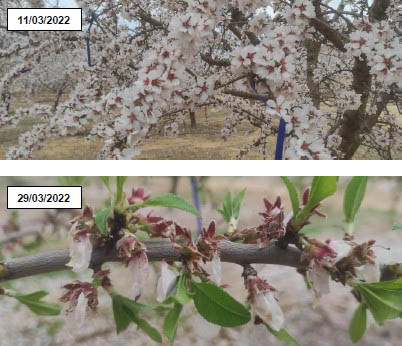
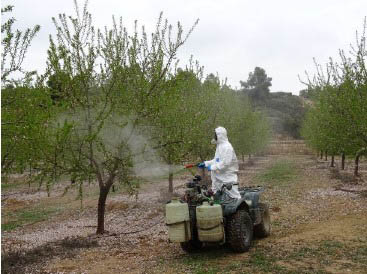
Applications: Two applications of the products were made, at the F (flowering) and G (petal fall) stages(Figure 1) at two different doses(Table 1). The product applications were made by foliar application, simulating a conventional application by means of a high pressure motor pump machine, with an approximate consumption of 100 liters/ha. Leaves and fruit were wetted without reaching the “run-off” point(Figure 2).
FIGURE 1. Phenological stages (F and G) at the time of product application.
FIGURE 2. Performance of one of the foliar applications made during the trial.
Timing of applications
NO.
Treatment
Product
Dosage (kg or L/ha)
No. applies.
Stage F (flowering)
Stage G (petal fall)
T1
WITNESS
–
–
–
–
–
T2
LABIN 1
LABORATORY
3
2
X
X
T3
LABIN 2
LABORATORY
5
2
X
X
LABIQUANTIUM
2
2
X
X
T4
LABIN 3
LABORATORY
5
2
X
X
TABLE 1. Treatments, product, dosage, timing of applications and time of application.
All applications coincided with the treatments carried out on the commercial farm for the prevention of diseases such as monilinia and ochre spot. Therefore, these applications should not be carried out intentionally, but would take advantage of the treatments for the control of the main almond tree diseases. The trees selected on the farm were of equal vigor, volume and productive potential. The significance of the mean values of the parameters analyzed in the different samplings was established using the ANOVA statistical procedure of the SAS statistical package and the comparison of the means in each parameter by means of Duncan’s test (alpha<0.05).
Results
Phytotoxicity
No phytotoxicity or alteration was observed during the course of the test, neither in leaves nor in fruits, attributable to the application of any dose of the product tested. during the course of the trial, neither in leaves nor in fruits, attributable to the application of any dose of the product tested.
Evaluation of fruit set
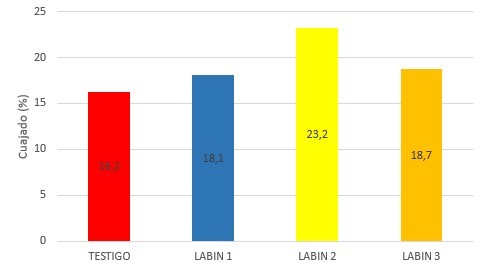
Figure 3 shows the results of fruit set in the first evaluation carried out 7 days after the second application. This year, VAIRO was 5 days earlier than the average of the last 10 years. In the figure, we can see that VAIRO had a normal fruit set in this first evaluation with average values of 16.2%. In all treatments there was an increase in almond fruit set (from 18.1% to 23.2%). The treatment with the best results, which increased by 7% with respect to TEST, was T3, LABIN 2 (application of LABICUAJE and LABIQUANTIUM in the same treatment).
FIGURE 3. Fruit set (%) of the variety "VAIRO" in the evaluation of April 4, 2022.
Economic study
Considering the normal situation of a production of 2000 kg of almond kernels/ha for the TESTIGO treatment, and considering that the increase in fruit set is directly proportional to 100% in terms of production increase, we have the following productions per treatment; TESTIGO: 2000 kg of kernels/ha LABIN 1: 2038 kg of kernels/ha (fruit set increase of 1.9% with respect to TESTIGO) LABIN 2: 2140 kg of kernels/ha (fruit set increase of 7% with respect to TESTIGO) LABIN 3: 2050 kg of kernels/ha (fruit set increase of 2.5% with respect to TESTIGO)
We observed increases from 38 to 140 kg of kernels/ha, thanks to LABIN treatments with LABICUAJE and LABIQUANTIUM products. If almonds are priced at 3 euros per kg of almond kernel, the profits are as follows: LABIN 1: 114 euros/ha LABIN 2: 420 euros/ha LABIN 3: 150 euros/ha
Profit range from 114 to 420 euros per hectare.
Assuming the following product application cost; LABICUAJE at 7 euros/kg and LABIQUANTIUM at 9.5 euros/L. We will obtain a total profit per hectare as follows: LABIN 1: 114 euros-42 euros= 72 euros/ha LABIN 2: 420 euros-110 euros= 310 euros/ha LABIN 3: 150 euros-70 euros = 80 euros/ha
Gains of 72 to 310 euros per hectare with LABIN treatments
Conclusions
The products LABICUAJE and LABIQUANTIUM did not show any phytotoxicity atthe doses and times applied under the test conditions.
The product LABICUAJE (T2) improved almond fruit set with respect to TESTIGO by 1.9% and in T3, when LABICUAJE and LABIQUANTIUM were applied together , the improvement with respect to TESTIGO was 7%.
An increase in the dose of the product LABICUAJE, when applied alone, does not result in significant differences in the increase of initial fruit set.
Clearly, when LABICUAJE and LABIQUANTIUM are applied together in the F and G stages of the almond crop, a synergy is obtained between them, which causes a substantial increase in the fruit set of future fruits.
The farmer will obtain profits between 72 and 310 euros per hectare by performing the LABIN treatments included in this trial.
It is interesting to be able to study if this same application at post-harvest times canincrease tree reserves, as well as induction and differentiation forthe following crop year.