Evaluation of LABIN fertilizer efficacy in corn crops
Essay
Location: Togo, Africa
Crop: IKENNE variety corn, grown in a 100 m2 plot (10 m x 10 m). Each elementary plot spaced 1 m apart and blocks spaced 1.5 m apart. The planting pattern is 80 cm between rows and 40 cm between spacing with 2 plants per spacing or 62500 plants/ha.
Objective: To test the agronomic efficacy and productivity of the corn crop by determining the optimum dose of LABINOR N-10 and LABIN’s Labifol 20-20-20 biofertilizer in corn, to test the national fertilization recommendation in corn and to compare the performance of conventional fertilizers and LABIN’s fertilizers in corn.
Control: Treatment without fertilizer (T5).
Dates: Late 2018-Early 2019.
Applications: 5 treatments and 3 replications. Sowing was carried out on September 21, 2018. NPK 15-15-15 and LABINOR N-10 fertilizers were applied 15 days later, according to the dose of each treatment (See Table 1). Urea and Labifol 20-20-20 liquid fertilizer were applied 1 month later.
Results
The results (see Table 2) show that the overall average yield of this trial has a coefficient of variation of 12.6%, which value expresses the homogeneity of the trial.
Treatments (T)
Grain yield (kg/ha)
T1
4349
A
T2
4527
A
T3
3947
AB
T4
2863
AB
T5
2007
C
Overall average
3540
CV% 12.6% 12.6% 12.6% 12.6% 12.6% 12.6% 12.6%
12,6
ppds
1909
Significance
S
Duncan’s test (5%): Numbers assigned to the same letters are not significantly different from each other.
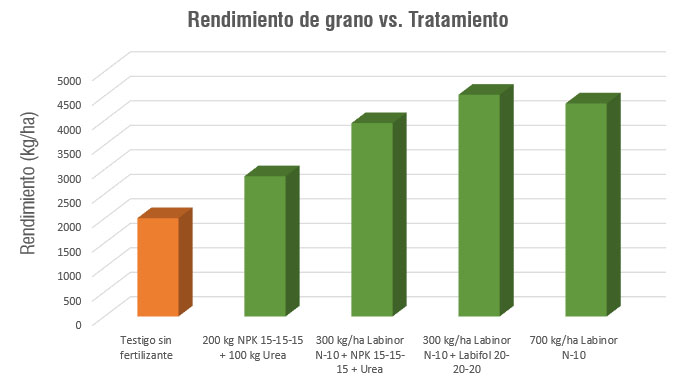
The yields (see Graph 1) of treatments T1 and T2, although statistically equivalent to each other and to treatments T3 and T4 (national recommendation for fertilization), are still statistically significant to T5 (no fertilizer).
This allows us to affirm that LABIN fertilizers, used alone or in combination with chemical fertilizers under the conditions of the current national reference rate, have allowed us to improve corn yields by 38% (for T3) to 58% (for T2) compared to the yield obtained from the recommended rate with conventional chemical fertilizers (T4), and by 118% (for T1) to 125% (for T2) compared to the practice without fertilizer.
Based on these results, we affirm that LABINOR N-10 biofertilizer is agronomically more efficient in the evaluation of yield in a corn crop with respect to the application of conventional chemical fertilizers, as well as in comparison to the non-application of fertilizer.
Conclusions
Under the conditions in which the trial was conducted, it can be concluded that the agronomic tests carried out with LABIN fertilizers obtained significantly better results (38% (for T3) and 58% (for T2)) compared to the other treatments (T4) and demonstrated that LABIN fertilizers are efficient from the agronomic point of view (118 to 125% increase in yield compared to no fertilizer application) and can contribute significantly to improving grain yield in the corn crop.